Lưu trữ Blog

Được tạo bởi Blogger.

Chủ Nhật, 2 tháng 8, 2009

I recently saw Watchmen on DVD. Like so many movies today, it is a mixture of superb special effects, solid writing and acting, and unspeakably gruesome and wholly unnecessary violence – along, of course, with an equally gratuitous sex scene or two. (In this it is like the late-1980s comic book on which it is based.) Of course, we are never supposed to criticize such things. “It is Art – causa finita est!” The Coliseum isn’t really evidence of decadence, you see, as long as the gladiators’ dialogue is well-written and artfully spoken.

Anyway, that’s not my theme here. If you haven’t seen the movie, I don’t think I’ll spoil it for you by noting that it is a superhero saga about the temptations and alleged moral ambiguities entailed by having super powers – “Who watches the Watchmen?” and all that. I say “alleged” because I don’t think the story’s key examples are ambiguous at all: they’re just flatly immoral actions, even if done for what a consequentialist might regard as good reasons. The most important examples involve the last twenty minutes or so of the movie, which I won’t describe (for the sake of those who plan to watch it) except to say that they entail mass murder and deception on a gigantic scale perpetrated so as to secure world peace. There are other actions performed by the character Rorschach which are portrayed as harsh but just – Rorschach is the one firmly anti-consequentialist voice throughout the movie, and is apparently supposed to be something like its “moral center” – but which are in reality unjust acts of vigilantism.

To be sure, the movie does not clearly endorse even Rorschach’s actions and attitudes; the emphasis throughout is on chin-pulling ambiguity. Like Dr. Manhattan (the most powerful and aloofly “god-like” of the Watchmen), we’re supposed to “understand” rather than either “condone” or “condemn.”

Now, here’s what I don’t get. The movie takes place in an alternate-universe 1985 in which Richard Nixon is in his fifth term, has imposed an authoritarian political order (even shutting down the Watchmen when they no longer served his purposes), and has brought the country to the brink of nuclear war with the Soviet Union. We are clearly supposed to despise this alternate reality “Tricky Dick” as much as lefties despised the real McCoy. Moreover, in the DVD commentary, some of those involved in the making of the movie and/or original comic book series claim that the story has clear relevance both to the time in which the series first appeared (the 1980s) and to the time the movie was made (late 2000s) – that is to say, to the Reagan and Thatcher years and to the Bush years. (Thatcher is relevant because Alan Moore and Dave Gibbons, creators of the comic series, are both Brits.) Clearly we’re supposed to despise Reagan, Thatcher, and Bush too, at least in the view of these commentators. And we all know why: because they’re “war-mongers” who “endangered our civil liberties” and perpetrated “illegal wars,” “torture,” and the like all in the name of freedom and justice. And though the forces they opposed – Communists and jihadists – were indeed evil, somehow Nixon, Reagan, Thatcher, and Bush were all almost as bad or even just as bad, indeed maybe even worse.

This standard left-wing/”civil libertarian” line on recent history is familiar enough, and I’m not going to debate it (or the details of the Cold War, Vietnam, the Iraq War, Gitmo, etc.) here. I don’t buy it for a second, but suppose for the sake of argument that it were true. The thing is this. Why is it that we’re supposed unequivocally to condemn and despise Nixon, Reagan, Thatcher, and Bush as moral monsters, and yet when some of the “heroes” in a movie like Watchmen carry out acts far more heinous than anything these real-world statesmen have been accused of, we are supposed to “understand,” or at least to revel in the purported moral ambiguities? Why must we scoff at the “simplistic” “cowboy” rhetoric of Reagan and Bush and yet sympathize when Rorschach (who despises “liberals” as soft on crime and who in one absolutely horrific scene hacks a child-killer’s face to grisly pieces) is characterized as “lovable” and the “favorite” of fans of the comic book and movie (as one of the voices in the DVD commentary puts it)?

I think some conservative writer or other made a similar point about The Dark Knight, which also has as one of its themes the morally problematic nature of the superhero’s methods. (And it explores the theme with much greater plausibility too, since all Batman does is monitor a bunch of private cell phone calls or some such thing – nothing like the mass murder or even harm of innocents is ever contemplated, much less carried out.) But Watchmen invites such questions all the more, given not only the far more heinous nature of some of the “heroes’” actions, but also the subtle-as-a-sledgehammer smearing of Nixon precisely in the course of emphasizing the “moral complexity” of “super-heroic” mass murder of innocents for the “greater good.” (I say “smearing” not because Nixon was innocent of wrongdoing or even a good president – he was neither – but because there is no reason whatsoever to think either that he was capable of the degree of authoritarianism the movie has him imposing, or that he would be blasé about the prospect of nuclear war, as the movie makes him out to be.) Why the double standard?

Saying “It’s just a movie, that’s why” is no answer. No one comes away from The Dark Knight thinking there is any ambiguity in the Joker’s actions or empathizing with him in any way – he’s just evil, and that’s that, despite his being only a movie villain. Fantasy is not in this case, or in the case of movies about serial killers or dictators, thought to license speculation about whether such deeds are possibly defensible after all. But we are supposed solemnly to ponder Batman’s morally questionable actions – spying on the citizens of Gotham and thus violating their civil liberties for the sake of stopping a terrorist act and nabbing its perpetrators, not to mention beating up and scaring the crap out of various hoodlums in order to get information – and indeed we’re expected to sympathize with his plight. “The choice he makes is a morally dangerous one and yet what other choice does he have?” Etc. Yet when someone in the Bush administration roughs up some terrorists or monitors their phone calls, we’re supposed to see in him, not Batman, but the Joker. What gives?

The point is not “See, those damn hypocritical liberals are at it again.” It might be hypocrisy; perhaps lefty movie fans and comic book readers who see moral ambiguity in the actions of the Watchmen but pretend to see only evil in the far lesser “crimes” of Nixon, Reagan, Bush, et al. are merely letting their blind hatred for the latter cloud their judgment. But maybe not. Maybe there’s consistency at the moral level, and some aesthetic consideration underlies the difference in reactions. Again, the mere fact that the one case is pure fantasy cannot be the explanation, but some other feature might be. Perhaps it is the “distance” that a work of fiction provides: Had Nixon, Reagan, Thatcher, and Bush been fictional characters, perhaps the lefties who now see no moral ambiguity in their actions would have seen it; and perhaps lefties of the future who read about these conservative statesmen only as historical personages will be more inclined to cut them some slack. By the same token, were Watchmen-type superheroes real, perhaps those who see moral ambiguity in their actions would not see it. Maybe the comic-book-devouring Howard Zinn fan who now thinks the fictional Rorschach is “lovable” would regard a real-life version as a despicable fascist.

And yet this “aesthetic distance” theory does seem to collapse back into the inconsistency theory; the Howard Zinn fan is unlikely to find a purely fictional Pinochet-style right-wing dictator at all sympathetic, no matter how “complex” his actions and circumstances. And if “aesthetic distance” would not alter his attitudes in that case, why does it in the superhero case?

“Just askin’,” really. I don’t claim to know the answer.

Thứ Tư, 29 tháng 7, 2009

…this is how it would go (HT: Siris):

Julia Driver has written a useful article on Elizabeth Anscombe for the Stanford Encyclopedia of Philosophy. (HT: Siris) Imprint Academic recently published Faith in a Hard Ground: Essays on Religion, Philosophy, and Ethics by G. E. M. Anscombe, an anthology devoted to Anscombe’s work on theological topics (and a fascinating one, judging from the parts I’ve had time to read so far). If you’ve got a spare eighty bucks, Roger Teichmann’s The Philosophy of Elizabeth Anscombe also appeared recently. If you’ve been looking for some reading material for the last month of the summer, now you’ve got it.

Thứ Ba, 28 tháng 7, 2009

Suppose I asserted that the difference of the positions of B and G# in the A major scale was identical with, supervened upon, or was in some other way explicable in terms of, the greater than relation that the number 23 bears to the number 18. You would no doubt wonder what the hell I was talking about. Just as notes in a scale are one thing and numbers are another, so too are positions in the scale and positions in the sequence of numbers different things, and that’s that. Relations of identity, supervenience, explanation, etc. simply don’t hold between the two. (Of course, there are mathematical relationships between notes in a scale; the point is that the relationships between notes are clearly not reducible to or entirely explicable in terms of mathematical relationships.)

Note that this has nothing to do with the lack of a law-like correlation between the two – whatever that could mean in this context, since we’re talking about abstractions rather than concrete objects or events. And even if we reverted to speaking of concrete objects and events, we don’t think that the reason talk of identity, supervenience, etc. makes no sense in this context is that we find no regular correlation in nature between (for example) the playing of B on a musical instrument and there being 23 of something in the vicinity. Correlation or lack thereof just has nothing to do with it. Even if we found that some such bizarre correlation held, we wouldn’t think “Aha! B in the A major scale must be identical to or supervenient upon the number 23!” Such a claim would be just as unintelligible in the presence of the correlation as in the absence of it.

I propose that the same thing is true of claims like this: “Having a thought with the content that P is identical to, supervenient upon, or otherwise explicable in terms of having a sentence with the meaning that P encoded in the brain”; “The semantic-cum-logical relations between thoughts are identical to, supervenient upon, or otherwise explicable in terms of the causal relations between brain events”; and other claims of this sort. Such claims are simply nonsensical. Logical relations are one thing, causal relations are another, and that’s that. If you don’t see this, either you don’t understand what a logical relation is or you don’t understand what a causal relation is – or, more likely, you are in the grip of some ideology that leads you to speak nonsense. Similarly with the claim that having a thought involves having a sentence in the head. Having the thought that 2 + 2 + 4 – that is to say, grasping the proposition that 2 + 2 = 4 – is one thing, and having some sentence instantiated somewhere (whether on a chalkboard, in a notebook, in a computer, in a brain, or wherever) is another, and that’s that. If you don’t see this, then, again, either you don’t understand what a proposition is, or you don’t understand what a sentence is, or you are in the grip of some ideology.

The ideology in question is, of course, materialism (or physicalism or naturalism, if you prefer). If you start with the assumption that thinking simply must be identical to, supervenient upon, or otherwise explicable in terms of brain activity, then it will seem to you at least plausible that logical relations might be reducible to causal relations, thoughts identifiable with the having of brain sentences, etc. But no one would think these things plausible even for a moment if they were not already seeing the world through materialist glasses – indeed, they would take the evident absurdity of such proposals as prima facie evidence of the falsity of materialism. (And that is, I propose, part of the reason why most philosophers historically have not been materialists.)

“But what about the correlations holding between certain mental events and certain brain events?” Well, what about them? Again, no one would think for a moment that a correlation between (say) the playing of B on a musical instrument and there being 23 of something in the vicinity is even prima facie evidence for the plausibility of the claim that the difference of the positions of B and G# in the A major scale was identical with, supervened upon, or was in some other way explicable in terms of, the greater than relation that the number 23 bears to the number 18. Or if he did think so, it could only be because he is already in the grip of some bizarre ideology (Pythagoreanism?) which independently insists already on there being some deep metaphysical connection between musical relationships and mathematical ones – and which has deadened thereby his ability to spot clear category mistakes.

From an Aristotelian point of view, such correlations are in any event not the least bit surprising despite the falsity of materialism. Since soul and body are related as form and matter, mental and physiological correlations are no more surprising than the “correlation” that exists between the form of some particular tree and the matter than composes it. But in neither case is there any question of identity, supervenience, etc., since form and matter in general are simply irreducible.

Peter Geach said it well: “When we hear of some new attempt to explain reasoning or language or choice naturalistically, we ought to react as if we were told that someone had squared the circle or proved the square root of 2 to be rational. Only the mildest curiosity is in order – how well has the fallacy been concealed?” (The Virtues, p. 52) Like Pythagoreanism, materialism is philosophically interesting, often defended by thinkers of genius – and ultimately simply and clearly wrong.

Thứ Tư, 22 tháng 7, 2009

Now that the Michael Jackson hoopla has died down somewhat, I can tell my story. Or rather, since it has for some reason only now occurred to me that it might be worth a laugh to blog about it, I’ll do so. Yes, I met Michael Jackson.

It was the mid-1980s and I was working in a movie theater in the San Fernando Valley. Some Disney movie had just been re-released – I think it was Snow White, or Pinocchio. It was a slow summer weekday afternoon when he came in, with two bodyguards, to see it. (The man-child thing was a theme even then.) Few people were in the theater at the time, but naturally his presence caused a bit of a stir among those who were – this was just post-Thriller.

We had two encounters. (No cheap jokes, please; besides, I was all grown up by then, so...) First, when he came out of the restroom before the movie started, I happened to be putting up a rope line, within the theater, in preparation for some later movie. He nearly walked right into me and exclaimed, in startled falsetto, “Which way do I go?” Stifling a laugh, I pointed him in the right direction.

In those days, before the movie started, they used to show a promo for the Will Rogers Institute, asking for donations. The lights would come up, one of us ushers would go from row to row with a can collecting whatever people felt like giving, and then the regular trailers would resume. On duty that day, I had the honor of taking his donation. As I recall, he peered up over his sunglasses and, once again in falsetto, asked “Is this for Will Rogers?” as he handed it to me. I think it was all of a dollar. (Did I mention this was post-Thriller?)

And that was it, folks. If you’ve read this far, I’m sorry I can’t give you the last minute of your life back.
By the bye, if you take a ride in Doc Brown’s time machine back to circa 1984 and pop into Mann Valley West so as to witness my historic meeting with the King of Pop, do NOT eat the nachos. One of my co-workers was, shall we say, something of a prankster. ‘Nuff said.

Next in this exciting series: I see John Larroquette at a gas station in Studio City!
If you’ve been following the exchange with UnBeguiled in the comboxes here and especially in the post immediately below this one, you know that I’ve been trying very patiently to get him to see the difference between an empirical scientific issue and a philosophical or metaphysical one. His latest “response” (see the combox to the previous post) was to sum up my position as the claim that “Facts don’t matter.” See, if you so much as distinguish two fields of study – even two fields of study that everyone else also agrees are distinct -- then you must not care about facts. Got it? Me neither.

Could it get any worse? Turns out it can. In the combox to his own latest post, he opines that “Feser's statement [about the irrelevance of questions of physics to the argument from motion] effectively removes him from the community of reasonable conversation, but it seems to me it is much worse than that. His is an act of betrayal. He has betrayed our common humanity.”

It goes on.

This is, I must say, simply so bizarre and unhinged that I cannot even get angry about it. The guy is just out to lunch.

So long, UnBeguiled. Hope you can get the help you need, fella.

Thứ Ba, 21 tháng 7, 2009

Over at his own blog, UnBeguiled (occasional commenter at this blog) criticizes the argument from motion as presented in The Last Superstition. Unfortunately, he fundamentally misunderstands it. He claims that by “motion” I mean ”acceleration”; in fact, “motion” in the context of the argument means the actualization of a potential, and applies to all kinds of change, having nothing necessarily to do with local motion in particular. He assumes that the idea of a per se or essentially ordered causal series has fundamentally to do with a simultaneity of causes and effects; in fact it has to do with the instrumental character of (all but one of) such a series’ causes, their having (apart from the first member) no independent causal power. (Examples of simultaneous causes and effects are useful for illustrating the idea, and such a series is bound to trace eventually to a first cause operating here and now; but simultaneity per se is not what is doing the philosophical work.) In general he assumes that the argument has to do with physics; in fact it has to do with metaphysics (or, more precisely from a Neo-Scholastic point of view, with philosophy of nature, but the label “metaphysics” will do given the way that term tends to be used in contemporary philosophy).

Since I make all of this clear in the book, I don’t know why he so badly misreads the argument, unless it is because (to paraphrase Wittgenstein) a picture is holding him captive. That picture is scientism, the thesis that the questions and methods of empirical science are the only real questions and methods there are. Since scientism itself is not an empirical hypothesis, not something the truth or falsity of which can be established by empirical scientific means, it is (when not so qualified as to be no longer interesting) self-undermining. Somehow that never seems to weaken its grip over those beguiled by it, despite their oft-purported superior rationality. Having once hit upon the idea – usually as a reaction against some body of religious doctrine they’ve become disillusioned with – they fall absolutely head over heels in love with it and become insensitive to criticism. Scientism just can’t be wrong, you see, because when they first became aware that there was something called “reason” as opposed to “faith,” that reason appeared to them in scientistic form, and to abandon the scientism would seem to them to be to abandon reason too. This is tosh, but tosh that is all the more powerful to the extent that those who buy into it think themselves for that reason uniquely immune to tosh. It is no wonder, then, that despite the fact that I explain all of this too in the book, UnBeguiled remains UnUnBeguiled.

Anyway, be all that as it may: What UnBeguiled’s (apparent) scientism keeps him from seeing is that Aristotelian-Thomistic arguments for God’s existence do not take as their starting points premises to which empirical science as that field of study is understood today is relevant. They begin instead from premises that any such science must take for granted. (That is not to say that “physics” in some sense of the word is not relevant to an argument from motion, since the boundaries between science and philosophy are not carved up in Aristotelian-Thomistic philosophy the way they are by other traditions in philosophy. The point is just that the sort of premises that an argument from motion starts from would, the way things tend to be carved up by most scientists and philosophers today, better be thought of as claims in metaphysics or philosophy of nature rather than physics per se.)

In the case at hand, what is relevant is the actuality/potentiality (or act/potency) distinction. As those familiar with the history of ancient philosophy (and TLS readers) know, the origin of this distinction lies in Aristotle’s response to Parmenides. Parmenides attempted to demonstrate a priori that change is impossible. Aristotle responded, in part, that we can understand how change is possible when we see that there is, in addition to being and non-being (the notions Parmenides makes use of), the third category of what exists potentially – that which is not actual and may never be actualized, but which is not nothing either. Hence it is not enough to say of a rubber ball (to make use of an example from TLS) that it is actually solid and spherical but not actually melted and not actually the number 23. For it is melted in potency or potentially, but it is not the number 23 even potentially. Once we see this, we can see why change is possible: the ball can melt because in doing so it is not going from sheer non-being to being (which Parmenides argued was incoherent) but rather from being in potency to being in actuality.

There are other reasons why we must recognize an act/potency distinction. For example (and for reasons I spell out in TLS and have alluded to in previous posts), we have to recognize in all efficient causes something like final causality or directedness toward an end if we are to make causation intelligible at all. But to recognize this is to recognize the existence of potency as distinct from act, since a cause that is directed toward the generation of some effect even when it hasn’t yet actually generated it is in potency relative to such generation. The point, though, is that this whole discussion takes place at a deeper level than empirical science. Empirical science studies particular changes and causes; metaphysics or philosophy of nature studies the preconditions of there being any changes or causes at all. Empirical science reveals to us the specific mechanisms by which the reduction of potency to act (to put it the way the Scholastics would) occurs in this or that specific domain within the natural world; metaphysics or philosophy of nature reveals to us that such a reduction must underlie whatever those mechanisms turn out to be.

For Aristotle and the tradition he inaugurated, the most important instances of reduction of potency to act involved essentially ordered series in which some causes were instrumental relative to others (and of which simultaneous causes and effects are the most obvious examples). UnBeguiled insinuates that the notion of a per se or essentially ordered causal series is something trumped up for the purposes of religious apologetics. In fact it is nothing of the kind, unless you think Aristotle and other pagans were frantically concerned to prepare the way, millennia in advance, for Josh McDowell.

The sort of example that in TLS I follow Aquinas in using, viz. a hand’s using a stick to move a stone, is (as I note in the book) just an illustration to generate the key concepts; strictly speaking, a hand isn’t a first mover. And strictly speaking, quibbles over whether the movement of the stick occurs at exactly one and the same instant of time as the movement of the stone are not to the point either. As I emphasize in the book – and this is something UnBeguiled omits to mention – ultimately the stone, stick, and hand all depend for their very existence at any moment (forget about their movements through space) on the actualization of various potentials. For the muscles to exist here and now the potentiality of their constituent cells to constitute muscles must be actualized here and now; for the cells to be actualized in that potential, the potential of the molecules making up the cells to constitute cells must itself be actualized here and now; and so forth. This does imply simultaneity, but notice that (a) the point has nothing to do with acceleration, change of spatial location, etc., and (b) the point isn’t so much that the members of the series are simultaneous (though they are) but that they are essentially ordered: no molecules, no cells, no muscles.

The length of the series is irrelevant. As other Thomists have noted, even if an essentially ordered causal series could per impossibile go back infinitely far, since none of the causes in it have any intrinsic causal power there would have to be some purely actual unmoved mover outside it which keeps it operative. And by the same token, if there were even a single actualization of a potency, that too would suffice to lead us to a purely actual unmoved mover. Look around you; or don’t look around, just contemplate your own thoughts. Is there any actualization of a potential at all? Why, yes there is – and Boom, you’ve got your unmoved mover, whether immediately or at the end of a series. (Supposing the argument from motion is free of other problems, that is – here I’m just addressing the claims UnBeguiled makes.)

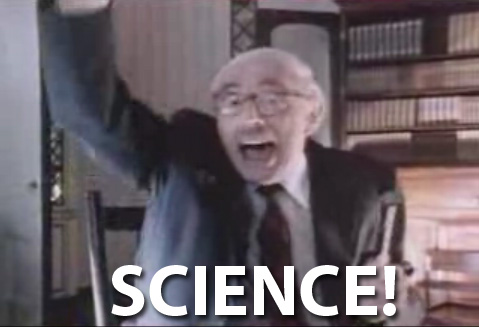
And lest UnBeguiled seek to quibble now over physiology, I should emphasize that the specific empirical details here are irrelevant as well. Whatever the details of the physics, chemistry, or physiology turn out to be, they are all going to involve the reduction of potency to act in essentially ordered causal series, because any material world at all is going to involve that. And that is all that matters for the argument. This is not “imaginary physics,” but the metaphysical precondition of there being any non-imaginary physical world at all. To refute the argument, then, it will not do simply to shout “Science!” What is needed is a serious philosophical evaluation; more Thomas Aquinas, less Thomas Dolby.